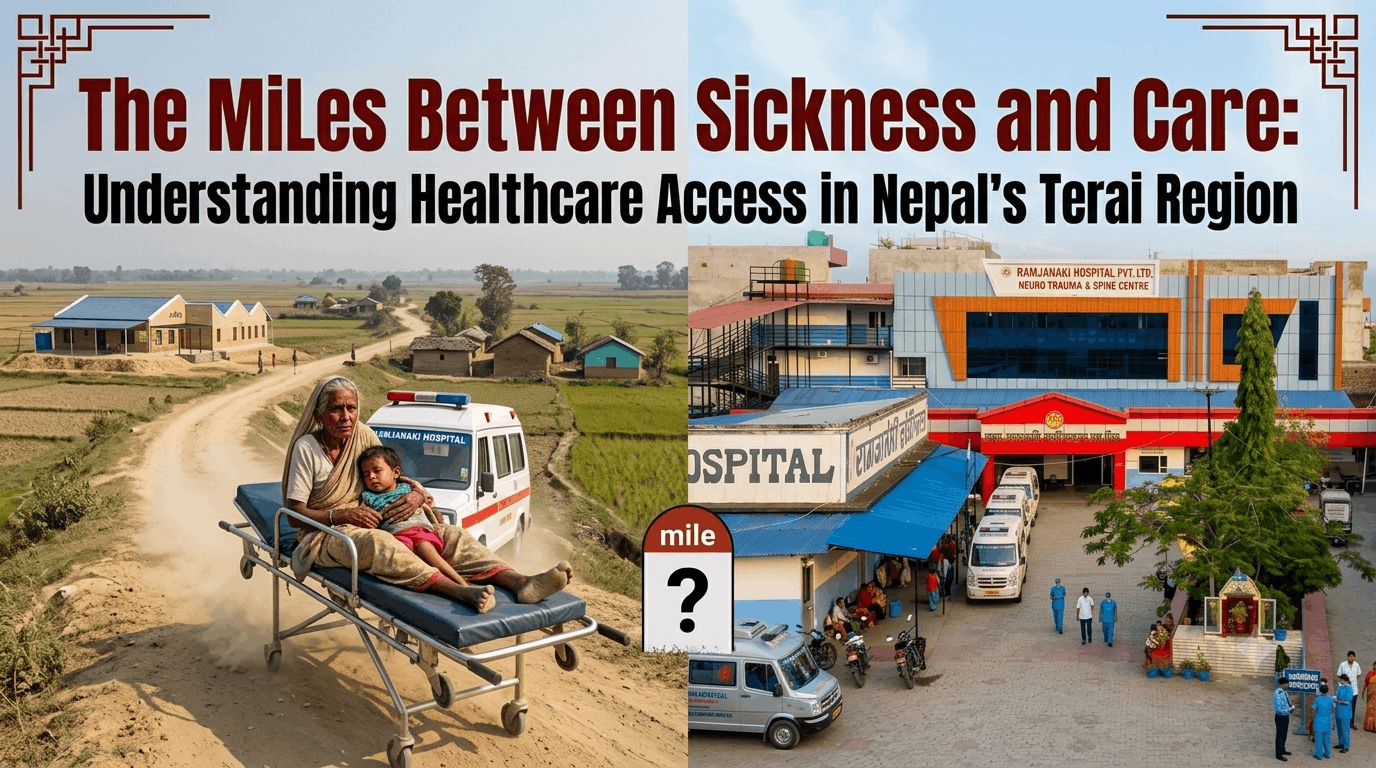
Why do Terai residents still struggle to access healthcare? This post explores the real barriers — and what hospitals like Ram Janaki are doing to close the gap.
Ask any family in Siraha, Sarlahi, or a village on the outer edges of Dhanusha what happens when someone falls seriously ill, and the answer follows a familiar, heartbreaking pattern. First comes the wait — hoping it will pass. Then comes the local clinic, which may or may not have the right medicine or equipment. Then comes the decision: spend money the family does not have and travel hours to Kathmandu or across the border to India, or stay and hope.
For millions of people in Nepal's Terai region, this is not a hypothetical scenario. It is a lived reality — shaped not by personal choices but by deep structural barriers that have defined healthcare access in the region for generations. Understanding these barriers is the first step toward changing them.
The Geography of Inequity
Nepal's Terai — the low-lying plains stretching along the southern border — is home to nearly half of the country's population, yet it has historically received a fraction of its healthcare infrastructure investment. While Kathmandu and major hill cities developed teaching hospitals, specialist centers, and medical colleges, the Terai's dense, rural population was served largely by under-resourced district hospitals and small private clinics with limited specialist capacity.
The result is a geography of inequity. A patient in Janakpurdham needing a neurosurgeon, a cardiologist, or a neonatal intensive care unit historically had one realistic option: travel. For those with money, connections, and mobility, this was manageable — difficult, but manageable. For the elderly, the very poor, daily wage workers, pregnant women in labor, or critically injured road accident victims, the journey itself became part of the medical crisis.
Distance is not just an inconvenience in healthcare. It is a clinical risk factor.
Social Determinants Shaping Terai Health
Beyond geography, a cluster of social and economic factors shapes health outcomes in the Terai in ways that clinical care alone cannot address.
Poverty and out-of-pocket cost remain the single biggest barrier to healthcare access in the region. Nepal's national health insurance scheme has expanded in recent years, but coverage gaps, documentation requirements, and low awareness mean that many Terai residents — particularly from marginalized communities — still pay entirely out of pocket. A single hospitalization can push a family into debt.
Literacy and health awareness play a significant role. In many communities across Dhanusha and Madhesh Province, limited health literacy means that symptoms are ignored, home remedies are relied upon too long, and patients arrive at hospitals only when conditions have become severe and harder to treat. Preventive care and early diagnosis remain underutilized.
Gender barriers are particularly acute in maternal health. Despite national progress, early marriage, low female decision-making power in some households, and cultural hesitancy around institutional delivery continue to affect women's access to safe maternity care in parts of the Terai.
Occupational health risks are substantial in a region where farming, brick-making, construction, and daily labor dominate employment. Musculoskeletal injuries, pesticide exposure, heat-related illness, and respiratory conditions from dust and smoke are common — yet occupational health services remain thin across most of the Terai.
What Community Outreach Looks Like in Practice
Hospitals and health institutions in the Terai are increasingly recognizing that waiting for patients to arrive is not enough. Proactive community engagement — health camps, free screening days, school health programs, and public awareness campaigns — is becoming a key part of the healthcare response in Janakpurdham and Dhanusha.
Ram Janaki Hospital has been part of this outreach philosophy, reflecting founder Ganesh Kumar Sah's vision of building a healthier society — not just treating individuals when they fall sick, but engaging communities in their own health. Health awareness, accessible OPD pricing, and multi-specialty availability in one location all reduce the friction between a community member recognizing a health need and actually seeking care.
The role of social media and digital health information is also growing. Platforms like Facebook and TikTok — widely used across the Terai — are becoming channels through which hospitals can share health education, symptom awareness, and service information with communities that traditional outreach may not reach.
Practical Takeaways for Terai Residents and Families
Know your rights. Nepal's government health insurance (Swasthya Bima) covers a range of services. Check whether your household is enrolled, and ask your nearest hospital what is covered before assuming you cannot afford care.
Don't wait until it's serious. Early consultation for persistent symptoms — prolonged cough, unusual pain, unexplained weight loss, high blood pressure — almost always leads to better outcomes and lower total cost than delayed emergency treatment.
Use local specialist services. With hospitals like Ram Janaki Hospital offering 17 specialist departments in Janakpurdham itself, the assumption that "real care" requires travel to Kathmandu is increasingly outdated. Ask your local hospital what specialists are available.
Talk about mental health openly. In many Terai communities, mental health struggles are still hidden. Recognizing that depression, anxiety, and emotional distress are medical conditions — not personal failures — is a vital community shift.
The barriers to healthcare access in the Terai are real — but they are not insurmountable. Every specialist brought to Janakpurdham, every health camp held in a rural community, and every family that chooses early consultation over dangerous delay is a step toward the healthier Madhesh Province we all deserve.
_1781666810.png)